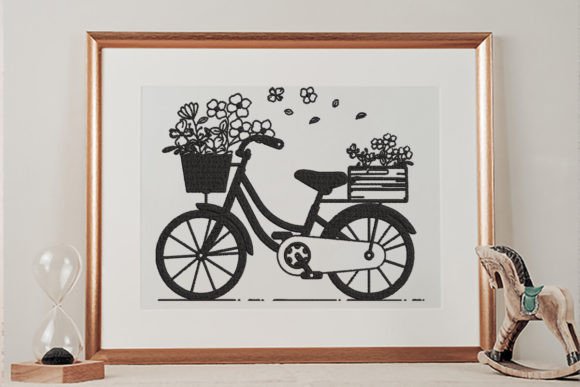
A Professional's Review of Bike Flowers Embroidery Design
From the perspective of a professional embroidery designer, evaluating a new machine embroidery file is a process focused on its potential for real-world business application. The design titled Bike Flowers immediately suggests a blend of casual charm and structured form. Based on the description of a Single Flowers category design meant to embellish fabrics, my first impression is that this design leans toward a playful, modern, and friendly aesthetic. It feels less rustic or overly handmade, and more like a clean, decorative accent with potential for a wide range of commercial uses.
Business Potential for Branded Merchandise & Custom Apparel
For small business owners, embroidery shops, and product designers, the core question is: how does this design translate into professional branded merchandise? Bike Flowers offers significant versatility. Its nature as a Single Flowers design suggests it is likely a contained, focal image, making it an excellent candidate for a small, impactful brand mark.
Imagine a local café or bakery wanting to create a sense of community and charm. An embroidered patch of Bike Flowers on staff aprons or the chest of a uniform polo shirt would convey a welcoming, creative vibe. For a boutique or florist, this design could become the central emblem on tote bags, transforming a simple bag into premium, branded merchandise. Etsy sellers and craft businesses could use it as a consistent logo accent on product packaging, or stitch it onto the corner of tea towels or pillow covers to elevate a handmade product and boost its perceived value.
For apparel decorators and merch creators servicing businesses, Bike Flowers could be perfect for event merchandise or customer gifts. A small, elegant rendition on a cap for a creative studio, or a subtle sleeve detail on work shirts for a pet brand, adds visual consistency and fosters customer recognition. It’s these repeated, professional applications that build brand identity and trust.
Practical Application Across Key Products
Let’s break down its performance on specific items crucial for small business merch.
- Embroidered Patches: As a standalone embroidered patch, the design’s success hinges on its detail clarity at smaller sizes. A patch for a product label or a sew-on badge for a backpack needs to remain legible and attractive.
- Cap Embroidery: The curved, limited space of a cap front demands a design that is not overly dense or wide. Evaluating the stitch density and overall footprint of Bike Flowers is essential here.
- Tote Bag Design & Apron Embroidery: These larger, often textured fabrics are excellent canvases. The design can be scaled up more freely, but one must consider thread color contrast against the base fabric, especially for dark uniforms or bags.
- Uniforms & Work Shirts: For items that endure frequent washing, the design’s integrity is key. Areas with high stitch density or very fine detailed outlines might be prone to wear if not properly stabilized.
Where to Exercise Caution in Commercial Embroidery
While Bike Flowers appears versatile, a professional designer always identifies potential pitfalls before production. The primary considerations revolve around scale and fabric.
- Very Small Patch Sizes: If a client requests a tiny version for a product tag, you must test the embroidery file at that reduced size to ensure elements don’t blur or become lost.
- High-Detail Areas: If the design includes intricate outlines or small internal shapes, these can become challenging on highly textured fabrics like some tote bag materials.
- Thread Color Planning: For a floral design, the choice of thread colors dramatically affects its feel—playful vs. elegant, modern vs. classic. This choice must align with the client’s brand identity.
- Commercial Licensing: Before any business use, it is imperative to confirm the licensing terms of the digital embroidery file. Ensure it allows for commercial embroidery projects and resale on finished products.
Impact on Brand Identity & Professional Presentation
A well-executed embroidery design is a powerful brand asset. Bike Flowers, when stitched cleanly on quality merchandise, communicates attention to detail. It elevates a simple apron from generic to custom apparel, making staff feel part of a cohesive brand and customers perceive a higher level of professionalism. For a handmade shop or Etsy seller, using a consistent design like this across various items—tote bags, pillows, towels—creates a visual family that enhances buyer engagement and loyalty. It signals that the business invests in its visual presentation, which directly increases product value.
Essential Designer Notes Before You Stitch
Before running this design for a client’s merchandise, follow these practical steps to guarantee a flawless finished product.
- Test in Black and White First: Stitch a sample using a single high-contrast thread color (like black on white fabric) to assess the design’s fundamental structure and clarity without color distractions.
- Check Hoop Size Compatibility: The description doesn’t specify a required hoop size. Verify that the embroidery file fits the hoop sizes you commonly use for patches, caps, and apparel.
- Test on Real Fabric: Don’t rely solely on the digital preview. Stitch it on a scrap of the actual fabric you’ll use for the project—whether it’s twill for a cap, cotton for a shirt, or canvas for a tote bag—using the proper stabilizer.
- Create a Printable Mockup: For client approval, generate a mockup showing Bike Flowers on the intended product. This visualizes the application and avoids misunderstandings.
- Compare Beside Other Assets: If this design is to join other brand logos or graphics, stitch a sample alongside them to ensure visual harmony and consistent scale.
- Inspect Spacing & Density: Look closely at the stitch spacing in the sample. Areas of overly high density can cause fabric puckering or be uncomfortable on wearable items like caps.
In conclusion, Bike Flowers presents itself as a charming and adaptable machine embroidery design with substantial potential for small business merchandise. Its friendly, modern character can strengthen brand identity across uniforms, patches, and branded products. However, its successful transition from a cool embroidery design to a professional brand asset depends entirely on meticulous testing, careful application planning, and a clear understanding of its technical parameters. By approaching it with this professional lens, embroidery designers and business owners can confidently turn this digital file into a valuable, recognizable part of their commercial embroidery portfolio.